Training & Resources
Policy Development & Guidelines
The Office of Policy & Accreditation Compliance is committed to ensuring that all university policies are clear, consistent, and accessible to the campus community. Our policy guidelines provide a structured approach for proposing, reviewing, approving, and maintaining policies that support the mission of Southern University and comply with applicable laws, regulations, and accreditation standards.
These guidelines help faculty, staff, and administrators:
- Understand the steps required to create, revise, or retire a policy.
- Promote transparency through a 60-day public comment period for new and significantly revised policies.
- Ensure policies are accurate, regularly updated, and published in the official university policy library.
- Support accountability by clearly identifying responsible offices and implementation procedures.
We encourage all members of the campus community to engage in the policy development process by reviewing proposed policies during the public notice period and submitting constructive feedback. Together, we strengthen governance, improve compliance, and create a safe, effective environment for teaching, learning, and service.
Policy Templates
Policy Development Package Transmittal (MSWord Format)
Executive Summary Template (MSWord Format)
Policy Template (MSWord Format)
Training Courses:
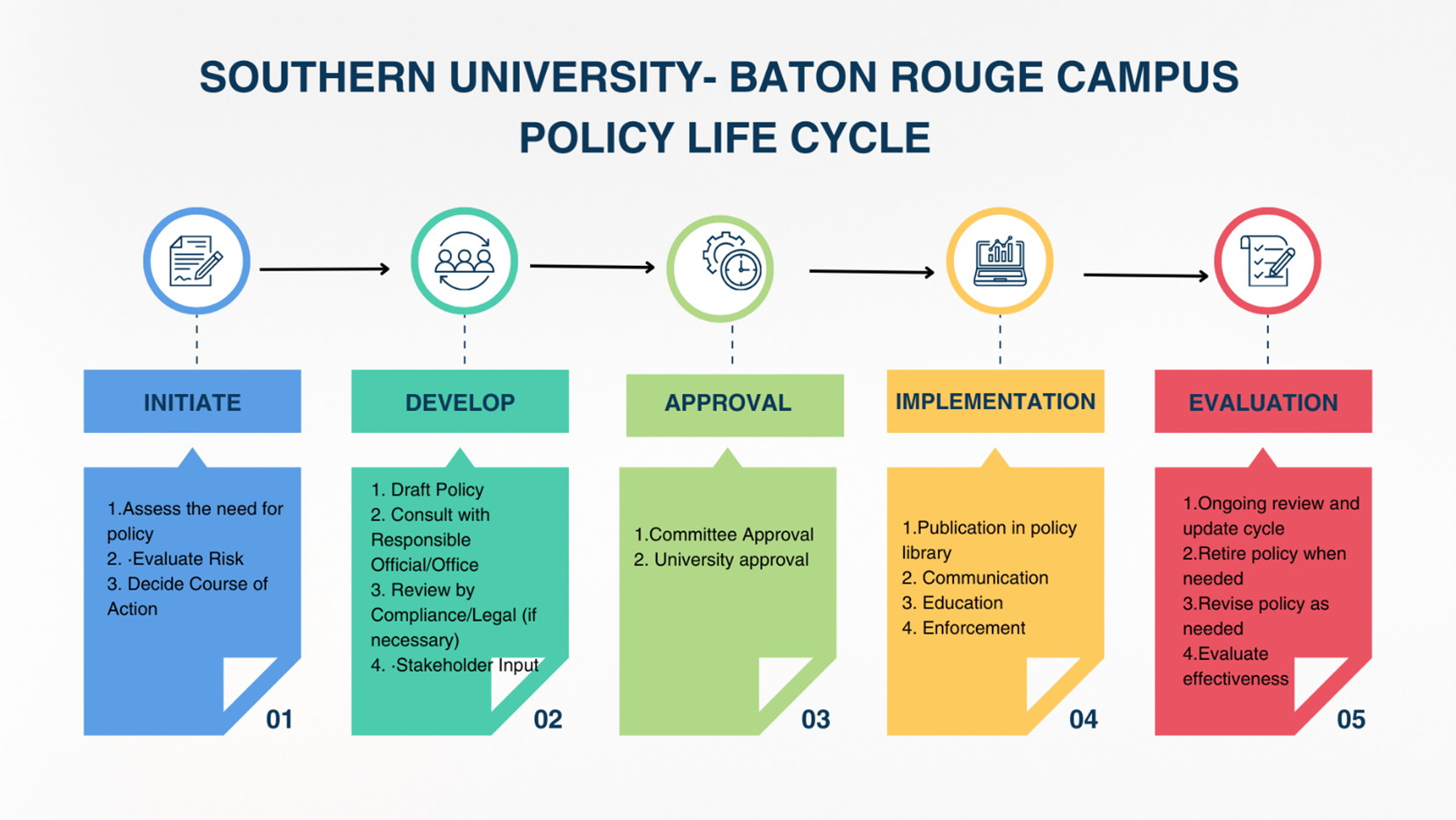
Policy Life Cycle
- Initiate (Pre-Development)
Identify the need for a new policy or revision (e.g., changes in law/regulations, accreditation standards, operational improvement, or risk management). Clearly define the policy’s purpose and how it supports the university’s mission and values. Engage appropriate stakeholders early, including subject matter experts and impacted units.
- Assess the need for policy
- Evaluate Risk
- Decide Course of Action
Purpose: Identify the need and authorize work on the policy.
Key components:
- Need Identification — risk, compliance requirement, legal mandate, accreditation standard, or operational gap triggers policy creation or revision.
- Sponsor/Owner Assignment — assign a responsible unit or policy owner (e.g., Academic Affairs, HR).
- Preliminary Impact Scan — determine stakeholders, alignment with strategic goals, and potential conflicts with existing policies.
- Approval to Proceed — the leadership or governance body authorizes policy development.
- Development
Use clear, concise, and inclusive language that is understandable to the intended audience.
- Draft Policy
- Consult with the Responsible Official/Office
- Review by Compliance Officer/Legal Review (if applicable)
- Stakeholder Input
Purpose: Draft a clear, compliant, and implementable policy.
Key components:
- Research & Benchmarking — review laws, regulations (e.g., FERPA, SACSCOC), peer practices, and internal procedures.
- Stakeholder Engagement — consult subject matter experts, faculty, staff, and legal counsel as needed. (60-day public notice)
- Drafting — use a consistent format (title, purpose, scope, definitions, responsibilities, procedures, references, effective date).
- Risk & Compliance Review — ensure alignment with statutes, accreditation, and audit standards.
- Internal Review — circulate draft for comment, make revisions based on feedback
- Approval
Submit draft policies to the Office of Policy for preliminary review to ensure clarity, consistency, and compliance. Obtain feedback from key stakeholders and governance bodies as appropriate. Secure required approvals through the established university review process (e.g., Academic Affairs, legal counsel, Executive Cabinet, and President/Chancellor’s office, as applicable).
- Committee Approval
- University Approval
Purpose: Formally adopt
- Formal Approval — obtain sign-off from the governing body (President, Cabinet, Board, etc.).
- Implementation
Once approved, policies are published in the official SUBR Policy Library. Communicate policy updates to affected campus groups through email announcements, training sessions, and the university website.
- Publication in the SUBR policy library
- Communication
- Education
- Enforcement
Purpose: roll out the policy effectively.
Key components:
- Communication Plan — announcement via email, policy website, training, and town halls.
- Accessibility — post final policy in the official repository/portal with version control.
- Training & Tools — create user guides, FAQs, or checklists to support adoption.
- Effective Date & Enforcement — clearly state when the policy takes effect and who enforces it.
- Evaluation (Monitor & Review)
Policies will be reviewed regularly to ensure accuracy, continued relevance, and compliance with applicable regulations. Suggested edits or updates should be submitted to the Office of Policy for review and processing
- Ongoing review & update cycle
- Retire policy when needed
- Revise policy as needed
- Evaluate effectiveness
Purpose: Assess effectiveness and ensure continuous improvement.
Key components:
- Compliance Monitoring — track adherence (audits, reports, dashboards).
- Effectiveness Review — assess if policy meets its intended purpose and mitigates risks.
- Feedback Mechanism — allow users to report challenges, ambiguities, or unintended effects.
- Scheduled Review Cycle — establish review frequency (e.g., every 5 years or sooner if law/regulation changes).
- Revision or Retirement — update, replace, or retire policies when outdated.